Outside of the internet, and periodically deciding that I’m a writer or painter, I have been trying to learn how to do more house projects beyond just painting a wall or changing a light bulb. I’m in my “forever” home now (I hope, the world is weird who knows what could happen, but forever is the plan). It’s a 1947 Tudor style(ish) cottage. It has undergone some light remodeling and updating over the years. Nothing is in particularly bad condition. There is some questionable wiring, and we may have to replace the water heater in a couple years, but other than that it’s in great shape. At some point a previous owner turned the walk up attic into a livable space with all knotty pine walls and built in drawers. It is lovely but like any older home there are improvements to be had, and issues to be resolved.
Shocking to absolutely no one I have detailed plans for each room, either in the form of vision boards in Miro, sketchbook notes & doodles, or just in my head. Every room has a planned design, color palette, and intended purpose. Does reality align with any of these plans and ideas? Well. No, not yet. Everything is an ever changing work in progress and highly dependent on my motivation to actually do things.

“If every porkchop were perfect, we wouldn’t have hot dogs.”
– Greg Universe
So you can understand why I’d come up with something called “Hotdog Planner”. Greg Universe (pictured) of Steven Universe fame, had a common saying “If every porkchop were perfect, we wouldn’t have hotdogs.” As a recovering perfectionist this idiom really resonated with me. House projects – as long as safety is adhered to – don’t have to be white glove perfect. To DIY you have to be aware that your house is not likely to ever look like a magazine. The lesson of “good enough” is a difficult one to accept, but it will serve you in the long term. I’ve found the best way to get a result you can be happy with is to go in with a budget and plan and at least try to stick to them. The issue I run into is a lack of proper organizational tools for my novice/layman skill level.
The planner I’m working on is loosely based on my experience working in software management apps. I have found when planning a house project it ends up sort of scattered. The place I keep links to products is separate from the budget (if I even have one) and if things are connected it is through a spreadsheet that becomes cumbersome and not worth using. As with the other small projects here, I just wanted something kind of plain. I am not, nor will I ever be, a contractor. I don’t need to manage a $100,000 renovation with ten different sub contractors. I don’t need all the extra bits that come with something like Jira. I just need a little more than a basic free system offers, and a little less a paid one does. I need a hotdog level system.
As with the in-progress Physical Media Library I will share my requirements doc here.
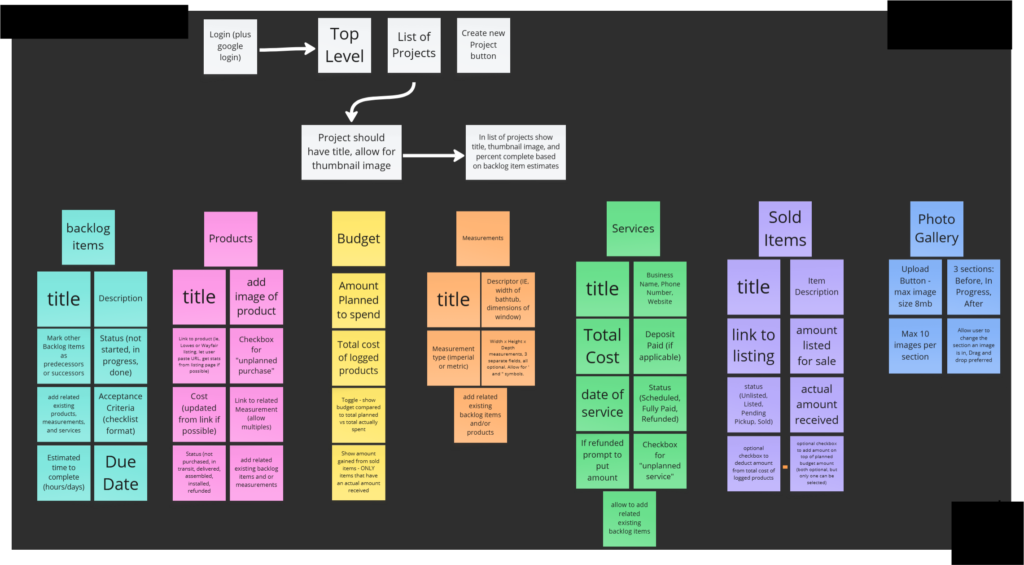
This time I was able to set up my repository, database, etc without the help of Claude; Small victories I suppose. Something a bit funny – Claude will provide you a plan of action before it builds something large. At the bottom of the one based on the above requirements it had a note about only reminding me once to set FTP info up, because memory shows I don’t like being nagged. Claude’s internal notes include my nagging tolerance.
It’s not wrong.
A small update on Physical Media Library: I have a working prototype, but I am currently the bottleneck as I plan to design the UI myself and that takes time. I’m feeling particular because I want it to feel like Blockbuster or a grungy record store (maybe give both options as themes). Claude defaulted to designing it in the same fashion as Bookathon, which is fine while nailing down feature functionality, but it lost some of the other requirements along the way. I’ve gotta write up a “To-Fix” doc along with getting UI/Palettes made.